

Forget the short-term noise. According to HSBC Private Bank’s latest Q3 2026 Investment Outlook, the next major wave of global growth isn’t just about recovering from inflation—it’s about a strategic pivot driven by artificial intelligence, energy independence, and national security.
The bank argues that intensifying global competition and shifting defense priorities are creating the necessary urgency—and policy backing—to sustain capital markets. With governments and corporations scrambling to diversify supply chains and energy sources (a lesson hard-learned from the COVID shock), the stage is set for a structural shift that will support both economic and corporate earnings growth.
Navigating Volatility with a Long-Term Lens
While the global economy remains resilient, HSBC warns that volatility is “here to stay” as markets react to fast-moving headlines. However, the firm expects this turbulence to be manageable.
“The priority is to stay disciplined with resilient and diversified multi-asset portfolios that can withstand short-term uncertainty, while keeping sight of longer-term opportunities emerging from structural growth trends,” said Willem Sels, Global Chief Investment Officer at HSBC Private Bank and Premier Wealth.
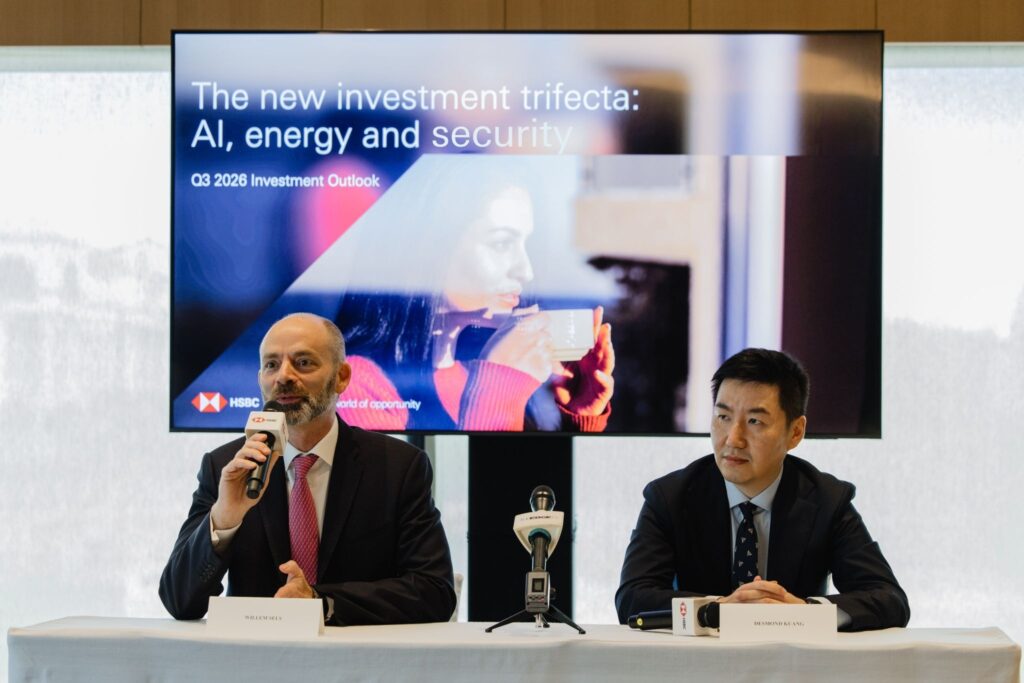
To that end, the bank is advising high-net-worth clients to focus on four key pillars for the third quarter of 2026, favoring growth-style companies over value names in sectors like tech and industrials.
The Four Pillars of the Q3 Strategy
- Double Down on the AI-Led Future: Despite recent sell-offs in software, HSBC sees a buying opportunity. Strong earnings surprises, easing monetization concerns, and attractive valuations make semiconductors, data centers, and AI adopters a prime target.
- Back Security and Energy Independence: Geopolitics are accelerating the pivot toward diversified energy supplies. Look for increased investment in electrification and grid infrastructure.
- Build Resilience with Multi-Asset Strategies: Bonds, gold, alternatives, and currency diversification remain the bedrock for stability. The bank is also eyeing infrastructure for its stable, inflation-linked cashflows.
- Tap Asia’s Innovation and Income: The bank suggests a “barbell strategy” to capture Asia’s innovation cycle while balancing with income. They are overweight on mainland China, Hong Kong, Singapore, and South Korea.
What This Means for Malaysia
For local investors, the outlook is cautiously optimistic. While Malaysia’s Q1 2026 GDP growth moderated to 5.4% (down from over 6% in Q4 2025), HSBC views this as a normalization rather than a trend reversal. The bank maintains its full-year GDP forecast at 4.5%.
“Domestic inflation has remained largely benign, with generous subsidies helping to keep petrol prices at bay,” noted Desmond Kuang, Chief Investment Officer for Asia at HSBC Private Bank (effective July 6, 2026). He also pointed to a geopolitical silver lining: “The ongoing Middle East conflict underscores the advantage of being a net energy exporter. While Malaysia is a modest net importer of crude oil, it is a major net exporter of natural gas, positioning the country favorably.”
Kuang adds that resilient domestic growth and steady corporate earnings are supporting the local equity market, leading the bank to retain a neutral outlook on Malaysian equities, albeit with a cautious eye on external volatility.
The Fed and The Bigger Picture
On the macro front, HSBC expects the US Federal Reserve to keep policy rates on hold throughout 2026 as it balances inflation and growth risks. Ultimately, the bank stresses that geopolitical developments are creating winners and losers across sectors and regions. In this environment, disciplined diversification is no longer just a suggestion—it’s a necessity.
Disclaimer: This article is based on a report from HSBC Bank Malaysia Berhad and is for informational purposes only. It does not constitute financial advice or a recommendation to buy or sell investments.